How to Host an Olive Oil Tasting Party
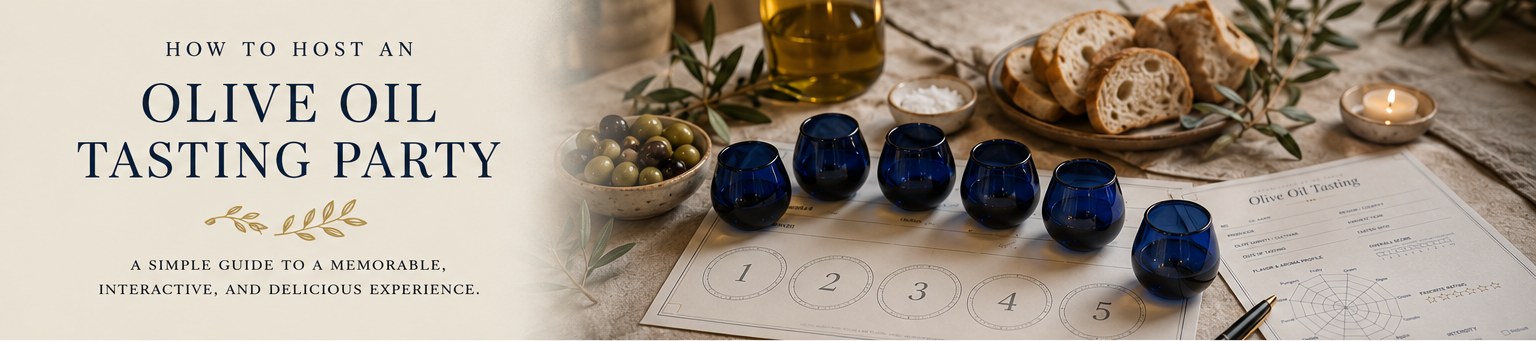
I hosted one of these last summer at an Airbnb in eastern Canada, with my family. We were on a lake, late at night, bugs chirping in the dark beyond the deck. I'd packed five bottles — sourced from a specialty shop in New York for different flavor profiles — and carried them across the border for exactly this moment. Tasting cups, napkins, the bottles lined up on the table. None of my family had ever done an olive oil tasting before. They all dove in. They're still talking about it — about the oils, about comparing notes on what each one tasted like, about how much fun it was to learn.
If you've been thinking about hosting one, this is the guide. None of it is hard. You don't need a sommelier certification, a custom flight tray, or thirty dollars per bottle. You need three to five oils, a few small cups, slices of green apple to reset the palate between sips, and the willingness to ask a table of people what something tastes like.
Step 1: Pick three to five oils
This is the only decision that really matters, and the easiest place to overthink it. The goal is contrast. If all five oils taste vaguely similar, the table goes quiet. If they're meaningfully different from each other, the conversation does the work for you.
The simplest approach: pick oils from three different countries. A Tuscan from Italy, a Picual from Spain, and a Koroneiki from Greece will all show you genuinely different flavor profiles. Add a California oil and a single-estate from somewhere like Croatia or Portugal if you want to stretch to five. If you only have two or three at home, two or three is plenty — you don't need a flight of seven to make this work.
A few things to look for at the store: a harvest date on the back of the bottle (not just a "best by"), a dark glass or tin to keep the oil from going rancid in light, and a country of origin that's specific (a region, not just "EU"). If the bottle has none of those, it's probably been sitting on a shelf for a year and won't taste like much.
Step 2: Set the table
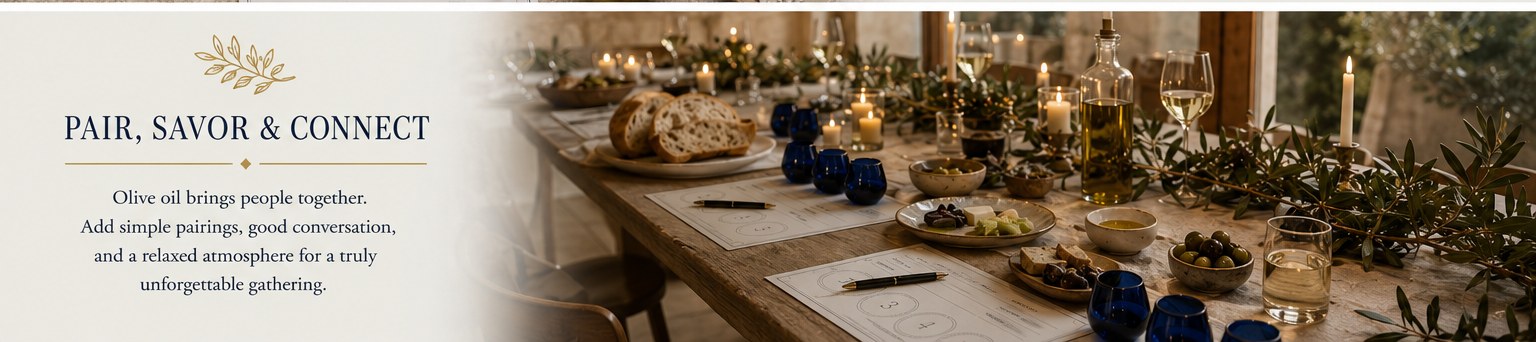
You want small cups, dark if you can get them. Sommeliers use cobalt blue tasting cups because color tells you almost nothing useful about an oil — a brilliantly green oil can be defective, a dull yellow can be exceptional — and the blue cup takes the visual out of the equation so your nose and tongue do the work. Espresso cups, small juice glasses, or even small mason jars work fine if you don't have tasting cups. Just keep the pour small (a teaspoon or two per oil per person).
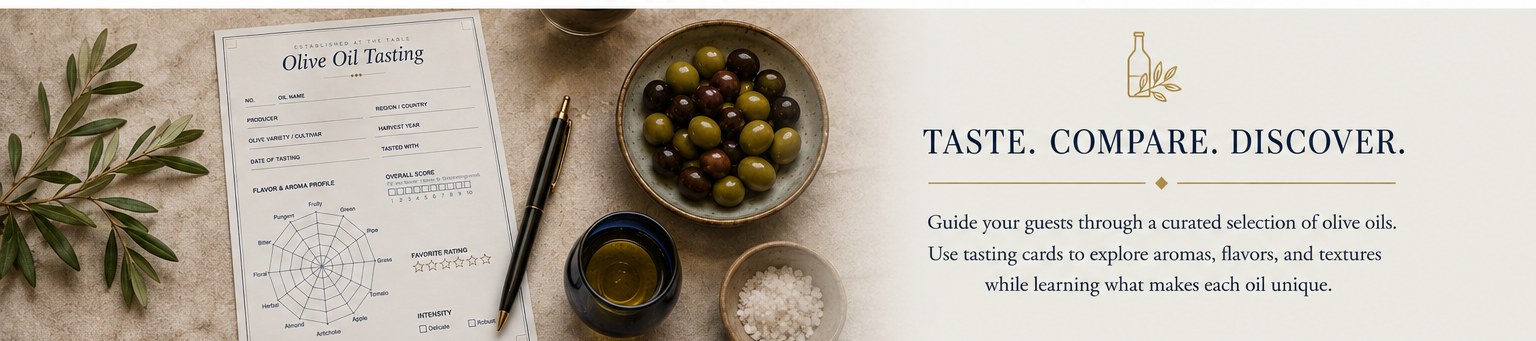
Lay out a numbered placemat or tasting card at each seat so people can keep track of which oil is which. I designed a printable party pack for this exact purpose — placemats, tasting cards, a host guide, flavor reference, and a pairing chart, all instant download, ready to print at home before guests arrive.
Step 3: Taste in the right order
Always go from the most delicate to the most intense. If you start with a robust, peppery Tuscan, the delicate Ligurian after it will taste like nothing. Mild first, robust last.
If you researched the flavor profiles before buying — most producers and good retailers describe their oils as delicate, medium, or robust on the bottle or product page — order them based on that. If you don't have that information, don't worry about getting the sequence perfect; a slice of green apple between oils does most of the resetting work for you. A sniff-check by itself isn't reliable for ranking robustness, so don't rely on that to sort them.
Here's how the actual tasting works, in five quick moves you can teach a table of guests in under a minute:
Warm the cup. Cup the bowl in one hand, cover the top with the other, and swirl gently for ten or fifteen seconds. Body heat releases the aromatic compounds. Don't skip this — it's the difference between smelling the oil and smelling the cup.
Smell. Uncover and breathe it in. Look for green grass, fresh-cut herbs, tomato leaf, banana, almond, artichoke. Not all at once. Just whatever shows up first.
Sip. A small amount — half a teaspoon — and let it coat the front of your tongue. Don't swallow yet.
Aerate. Pull air in through your teeth across the oil, like you're slurping it. It sounds weird and looks weirder, and most people laugh the first time they try it. This is what unlocks the bitter and pungent notes — the polyphenols that are the actual mark of a fresh, well-made oil.
Swallow and pay attention to the burn. A good extra virgin should make you cough a little. That throat-prickle is called pungency. It's a feature, not a defect. The longer it lingers, the higher the polyphenols, the fresher the oil.
Then write down what you noticed before you move to the next one. Memory blurs fast — by oil three, you won't remember whether the grassy one was number one or number two unless you wrote it down.
Step 4: Skip the bread — use green apple instead
This is the most common mistake. People assume an olive oil tasting needs a basket of bread on the table. It doesn't. Bread carries strong flavors of its own, fills up your palate fast, and makes it harder to tell oil three apart from oil four. The job of whatever you serve alongside is to reset the palate between sips, not add to what you're tasting.
Slices of green apple are the better tool. They're crisp, slightly tart, and clean the mouth quickly without leaving behind a flavor of their own. A glass of sparkling water with lemon between oils helps too. That's it for the actual tasting.
Bread is wonderful — just not during the active flight. Save it for an appetizer game before the structured tasting: pour a few oils into small dishes, hand out cubes of good bread, and let people dip and guess which oil they'd want at home. That's a great casual warm-up, especially if you've got a baker in the group. Then, when you sit down for the structured flight, the apples and water do the palate work and the bread can come back out for the meal afterward.
At the end of the tasting, the most fun thing you can do is have everyone identify which oil they'd want to keep using at home — drizzled over a soft scrambled egg, finishing a soup, dressing a tomato salad. This is where the conversation gets specific. People talk about meals they want to cook.
Step 5: Keep the notes
This is the part most people skip and most regret. You finish a beautiful tasting, you have a favorite, you tell yourself you'll remember which one it was — and three months later you're back at the store trying to remember whether it was the Spanish one or the Greek one with the long peppery finish. The bottle's empty. The notes are in a drawer. The memory's gone.
Take a photo of each label as you open it. Write down — even just one or two words per oil — what you noticed and which one you'd buy again. Or use the OlioAtlas app, which is what I built specifically for this problem. You log the oil, the producer, the harvest year, your tasting notes, and a rating. The next time you're standing in front of a shelf trying to remember that one I had in May, it's there. Your guests can do the same — and the next time you host, you'll already know which oils you want to compare against.
A few things people ask me
How many people is the right number? Four to eight. Three feels thin, ten gets logistically tricky around the small cups. Six is the sweet spot.
Wine or no wine? Save the wine for after. Wine deadens your palate for the oils, and you'll undersell what they actually taste like. A glass of sparkling water with lemon between oils works better than anything.
What if some guests don't really like olive oil? The ones who say they don't almost always discover, mid-tasting, that what they don't like is rancid or bad olive oil — and they've never had a fresh one. The faces change in real time.
Can I do this on a budget? Yes. Three good supermarket oils from three different countries (Italy, Spain, Greece — most stores have one of each) will already give you the contrast you need. Total cost: about thirty dollars. You can scale up to single-estate bottles and direct-from-producer oils later, once you know what your palate likes.
Set the table, pour small, taste in order, write it down. The rest takes care of itself.
Everything you need to host — printable cards, host guide, pairings, and a place to keep the notes.
Shop the Party Pack Get the iOS app